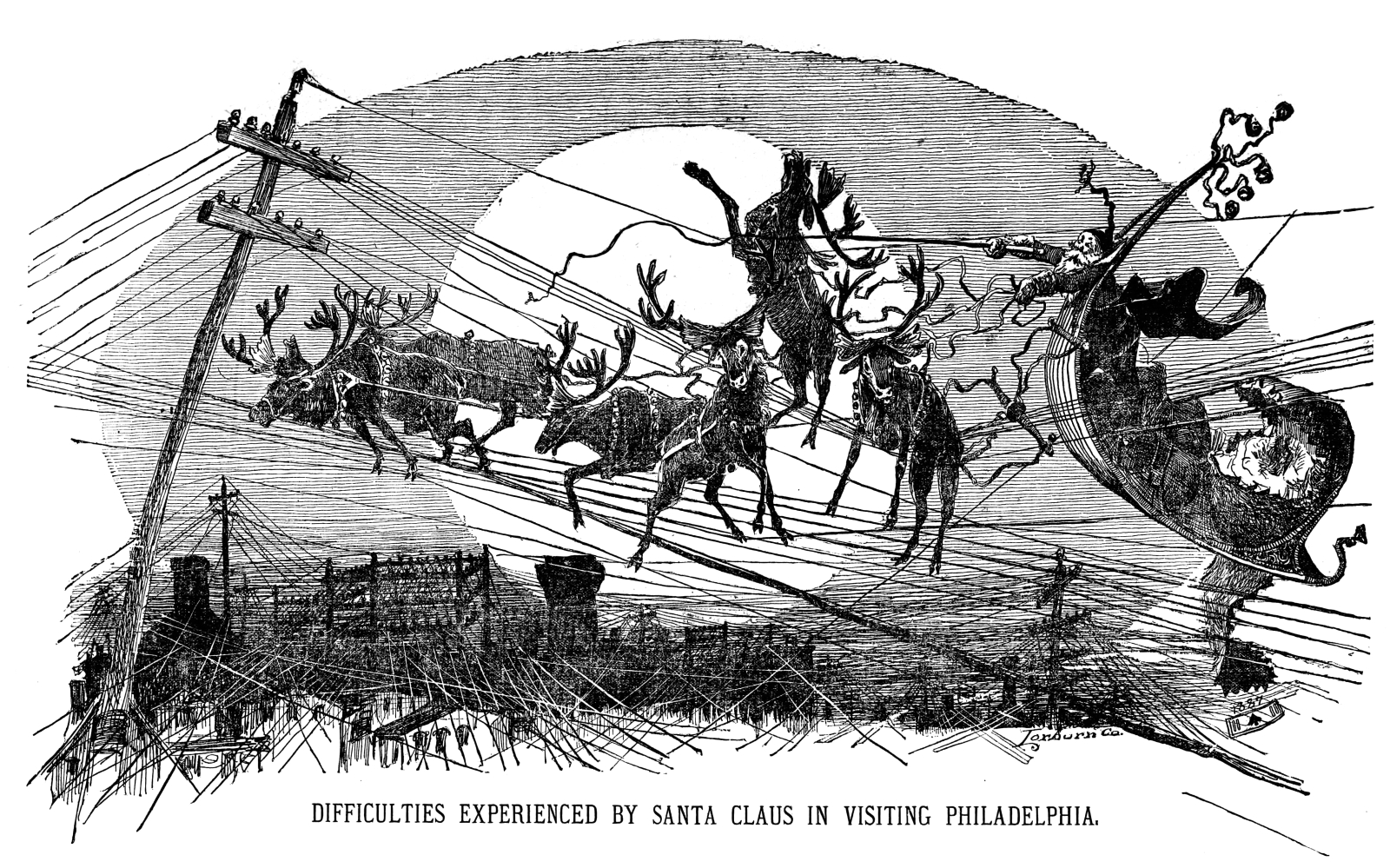
Cartoon from the Philadelphia Times, December 25, 1887
In searching for something to Christmas-y to feature on WaterHistoryPHL, I came across this somewhat off-topic cartoon from 1887, and couldn’t resist posting it today. It has nothing to do with water, but a lot to do with the landscape we live in.
Overhead wires for the use of telegraph and telephone companies, strung on tall wooden poles that took up valuable sidewalk space, became both a physical and aesthetic nuisance in the city center by the 1880s. In an 1879 editorial titled “The Worry of the Wires,” a Philadelphia Times writer railed against the wire problem. “Ugly poles [have grown] and multiplied upon us. Though they add nothing to the beauty of the scenery either of town or country, no scene seems complete without them. Alike in desert and forest and public road and crowded city, the graceless things rear their unbending heads. Before the poor man’s cottage and the rich man’s mansion and the shop of the shopkeeper and the mart of the merchant they proudly take their position and doggedly assert their right to stay. No sign may be erected on them, nor may any bills be posted.”
The editorial continued: “The wires, which are festooned from their tops, are not as ugly, for there is a sort of gracefulness in their sweep and their swing from polo to pole. They are not in the way of the foot passenger, nor do they rob us of pavement room. Yet their lack of positive ugliness is not enough of a redeeming feature to compensate for the sky-room they occupy, or for their defacement of the buildings in front of which they pass. What was endurable when only a few wires were elevated along our highways has become by unexpected increase an unbearable nuisance. The network of wires is in some places so voluminous as to make the heavens look like a gigantic rat-trap. The sky seems turned into hardware and streets into scaffolding for supporting it. In addition to the multiplication of public telegraph wires the great increase of private lines adds to the complication. The telephone, too, has become so popular that every respectable mercantile house must have communication with every other house in town. All this addition of telephonic wires has been erected within the past two years, and telephoning is yet in its swaddling clothes. When it shall grow and be on its feet…wires will multiply so abundantly that nobody will be able to find out from observation whether the sky is clear or cloudy. Our cities will be darker than London now is when encompassed by its heaviest fogs….Sun, moon and stars will cease to be acquaintances, and people who wish to keep alive their knowledge of these heavenly bodies will have to visit the country or go to sea.”
In the 1880s a city ordinance was adopted to require all wires, both for communication and electrical service, to be put in conduits beneath the streets. This took decades to accomplish, but today Center City (if not other Philadelphia neighborhoods) is free of unsightly overhead wires strung on poles. (Here’s an 1881 plan from the Streets Department showing the route of an early underground conduit in Center City, for the National Underground Electric Company.)
Harry Kyriakodis, in this excellent article from 2013 on the Hidden City website, provides more information about the wires that ensnared Santa and his reindeer in the cartoon above. And a website called Networks of Philly provides a visual key to all the manholes, handholes, and other infrastructure that now contain this multitude of wires out of sight.