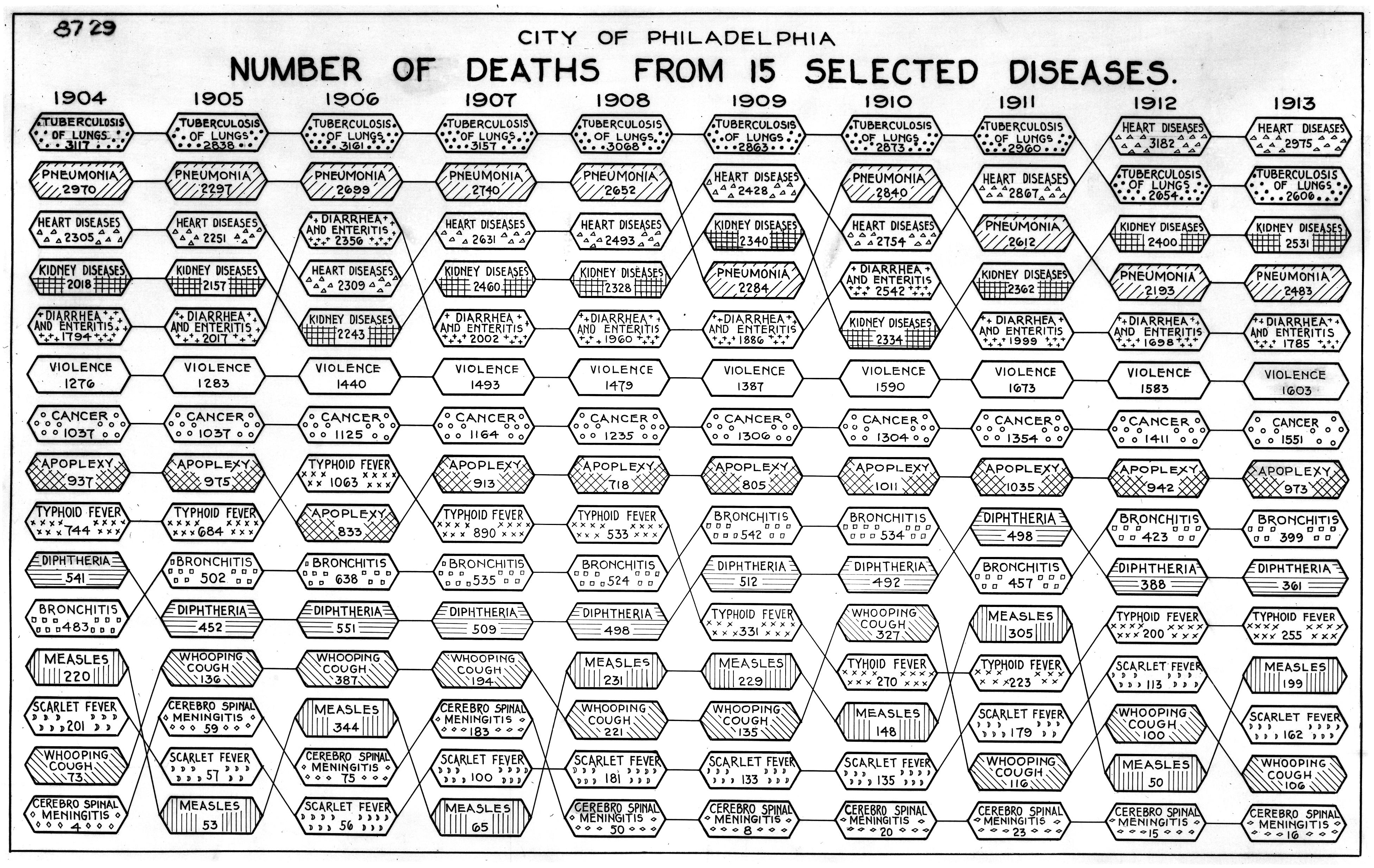
{Department of Records, City Archives, phillyhistory.org)
The background image shows typhoid bacteria, from a 1905 textbook.
When I talk about the historic effects of emptying the city’s sewage into the rivers from which we drew our water supply–a dangerous situation that water filtration plants built at the beginning of the 20th century, and sewage treatment plants at mid-century, have eliminated–I often mention various diseases that afflicted the population because of this. Besides typhoid fever, one problem was how the polluted water supply affected infants, giving them diseases like diarrhea that would dehydrate and, too often, kill them. I recently came across the following article that clearly states this problem, noting that it was often infants of poor families, who could not afford milk and instead gave their babies cheaper baby formulas mixed with water, that suffered most from this.
At the top of the page is an interesting chart of causes of death in Philadelphia from 1904 to 1913, from the collection of the Philadelphia Department of Records City Archives. You’ll see that the list includes the usual suspects–tuberculosis, pneumonia, heart disease, kidney disease, diarrhea and enteritis, cancer, apoplexy, typhoid fever, diphtheria, bronchitis, measles, scarlet fever, whooping cough, and cerebro-spinal meningitis–several of which are waterborne diseases. But I was also surprised and saddened to see that violence was included as a major cause, with an average of 1,480 violent deaths a year over the decade.
MORTALITY RATES OF PHILADELPHIA IN RELATION TO THE WATER SUPPLY
By John A. Vogelson, Chief of the Philadelphia Bureau of Health
In the absence of John A. Vogelson…his paper…was read by Dr. Neff, Director of the Health Bureau. Data was prepared to show the marked diminution of typhoid fever in district after district where filtered water was introduced. In 1906 the average rate of typhoid fever in the city was 72 cases per 100,000 population, and in 1912 the rate was only 12.5 per 100,000. This great drop in the typhoid fever was accomplished only after the filters had been put in operation. Tables were also compiled to show decreases in death rate from other diseases. It was noted that the greatest decrease in death rate was among infants under one year of age.
Philadelphia was engaged in improving its water supply by construction of filtration plants and rearranging its water supply distribution system from 1900 to 1911. The typhoid fever rates of such districts as received filtered water in the early development of the improvements began to decline immediately after the introduction of filtered water, and following the completion of the last of the five filtration plants in 1911 the typhoid death rate for the entire city shows a consistent decrease from 72.4 per 100,000 in 1906 to 12.5 per 100,000 in 1912. Isolated sections of the city, notably West Philadelphia, with a population of 267,840, had a typhoid rate of 5.9 per 100,000 in 1912. A large percentage of the typhoid which formerly scourged Philadelphia was undoubtedly waterborne, and the marked reduction of typhoid in this city is a notable sanitary achievement, due in by far the largest part to the filtration of the water supply. The average total mortality rate for nine years, 1862-70, was 2,291 per 100,000 and consistently declined to an average rate of 1,792 for the decade 1901-10, and still further declined to 1,522 per 100,000 in 1912, the lowest record rate in the history of Philadelphia.
Discussion
E. M. Hoopes, Jr., Water Department, Wilmington, Del .–I believe that the infant mortality rate under two years of age is a good indication of the general physical condition of the people of a municipality due to the water. Over 60 per cent. of the infant mortality has been reduced since the filters were installed in Wilmington. Tuberculosis also has apparently been reduced 35 per cent. The typhoid rate has shown the most remarkable change. In 1912 we had an apparent epidemic, as the filters were in bad condition. Since installation of the new system we have had a reduction in the number of typhoid fever cases of 60 per cent., and in deaths from typhoid fever of 53 per cent. We had fewer deaths last year from this cause than during any year since 1864, when the first records were kept. The final reduction to 54 cases last year was made when chlorination of the water was adopted .
R. W. Sherman–A former speaker stated that there were 54 cases per 100,000 population in his city and 12 deaths per annum. Will that gentleman kindly mention what the 54 cases were caused by?
E. M. Hoopes, Jr.—A large per cent. of these cases was caused by milk and fruit; also quite a number are due to people drinking water at vacation resorts. For all of these the city must take the blame.
R. W. Sherman–We have traced no cases of typhoid in our city to the city water. We do. however, find quite a lot of “vacation” typhoid at this season of the year when the people are returning from summer outings. A few cases have been traced to well water, and a few cases to milk. We had about 20 last year, which is a pretty good record for a city of 80,000 population .
Dr. Neff–The reduction in infant mortality is largely among babies under one year of age, and practically the entire decrease is among the poor. The better class of children under one year seldom use water, but drink only milk , whereas the poor use patented foods adulterated with raw water. It is estimated that at least 24 per cent. of the typhoid is caused by drinking polluted water. However, there are many other factors, such as flies, fruit, etc.; also eating vegetables after washing them in polluted water.
(SOURCE: September 24, 1913 issue of the weekly journal Fire and Water Engineering, part of a report on the New England Water Works Association’s 32nd annual convention, held in Philadelphia earlier that month. You can find the full volume 54 of this journal on Google Books.)