Second Philadelphia Water Works: Steam Power and Water Power at Fairmount, 1815-1909
Unless otherwise noted, all images are from the PWD Historical Collection. Main sources for this section include Nelson Blake, Water for the Cities (Syracuse University Press, 1956) and Jane Mork Gibson, “Fairmount Water Works” (Bulletin, Philadephia Museum of Art, Vol. 84, No. 360, 361, Summer 1988).
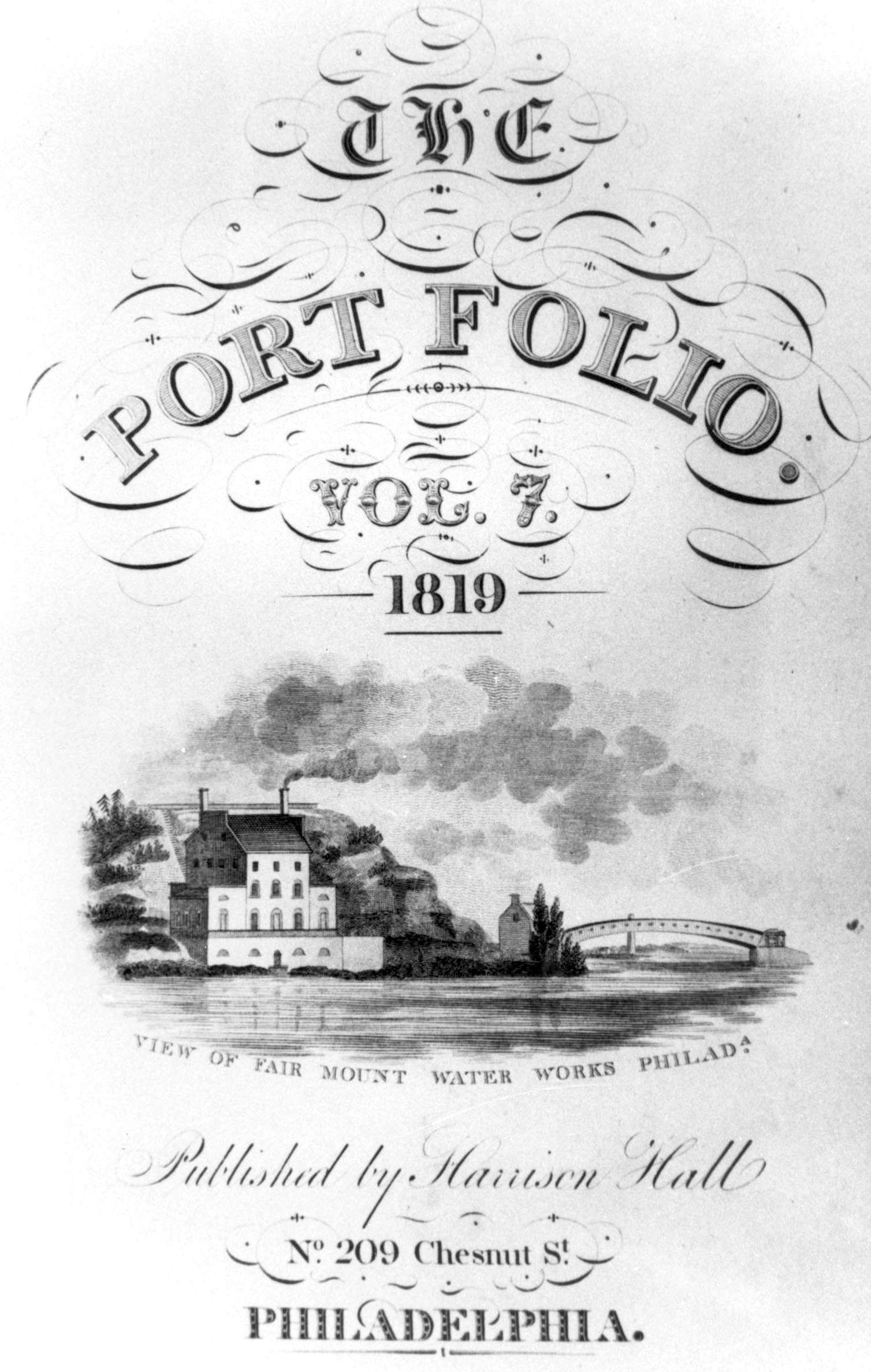
By 1811, it was clear to the Watering Committee, to City Councils, and to citizens who used the water supplied by the Centre Square Works that this original system would be unable to meet the city’s future water needs. In October of that year, the Watering Committee charged Frederick Graff, the current chief engineer, and John Davis, who had served as the water system’s first chief engineer, with the task of investigating other options by which the city might acquire a more reliable and abundant supply of water.
In December, Graff and Davis finished their report, which gave the Committee five alternatives. Among these were a couple of old ideas that were quickly removed from consideration. Tapping the Wissahickon with an aqueduct was dismissed because of the expense, and finishing the Delaware and Schuylkill Canal and using it as a water source was found, on closer inspection, to be impractical. They also proposed moving the Centre Square engine to the Schuylkill Water Works, so one engine could be a back-up to the other. A fourth alternative was to overhaul the existing system.
It was a fifth suggestion that both engineers favored, and which was ultimately adopted: building a new water works about a mile upstream from the Chestnut Street intake of the Schuylkill Water Works, at the foot of Faire Mount (also known as Morris’s Hill). A pumping station there with two steam engines would be more reliable, with one engine serving as a back-up to the other. At the top of the hill they proposed building a large reservoir that would hold three million gallons, a great improvement over the wooden tanks at Centre Square, which held less than 18,000 gallons.
From the heights of the reservoir, fifty-six feet above the highest ground in the city, water would flow by gravity into the existing system of pipes to businesses, homes and hydrants. This new system at Fairmount followed, but greatly expanded, the model established by Latrobe in the original water works: pumping to elevated storage and distribution by gravity flow.
Not everyone favored the change. Some prescient citizens suggested using the water power of the Schuylkill to pump water into the reservoirs rather than relying on steam engines—which is exactly what the city resorted to eight years later. But in the meantime, Graff and Davis received ample support for their steam-powered works. The plan was approved, the site at Faire Mount was purchased and ground was broken for the engine house at the foot of the hill on August 1, 1812. The new works began operation three years later, on September 7, 1815.

The new water works did prove more reliable, and did serve to greatly increase the supply, but it was still plagued by several problems. One was the system of wooden distribution pipes. In addition to leaks at many joints (where logs were joined and secured with an iron band), Graff admitted that friction in these pipes had been underestimated, and the many right angles taken by the pipes at street corners also slowed the flow of water.
This meant that the water pressure diminished more than anticipated as water traveled farther from the reservoir, which was a problem for some users at the far end of these pipelines. As a solution to this problem, the Watering Committee resolved in 1818 to lay only iron pipes for new and replacement mains.
Over the next three decades new cast iron pipes were laid and old wooden ones replaced until, by 1858, the last wooden pipes were taken out of service. The cast iron pipes had less friction, leaked less readily, and lasted far longer than the wooden pipes, in many cases a hundred years or more. A few iron pipes laid in the 1820s are still in service in the oldest parts of the city.

Another problem with the system was the steam engines themselves. Steam power was costly, with the wood burned to fire the steam boilers being the main expense. Only one engine was run at a time, and when it was suggested that both engines be run simultaneously to increase the supply, doubling the use of fuel was deemed prohibitive. Steam engines were still relatively new technology at the time, their construction and materials had yet to be standardized, and the boilers sometimes exploded. Two such explosions at Fairmount, in 1818 and 1821, killed several people, and provided further impetus to find a cheaper, more reliable, and safer power source for the pumps.
The solution was to adopt a suggestion made earlier by prescient citizens: harnessing the power of the Schuylkill River itself to pump river water into the reservoir. To accomplish this goal, the Watering Committee entered into an agreement with the newly-chartered Schuylkill Navigation Company, to which the state legislature had granted control of the water rights on the river. The City also paid damages to several factory owners at the Falls of Schuylkill, six miles upstream, whose water power would be flooded and thus destroyed by th erection of the dam at Fairmount and the subsequent raising of the water level of the river above the dam.
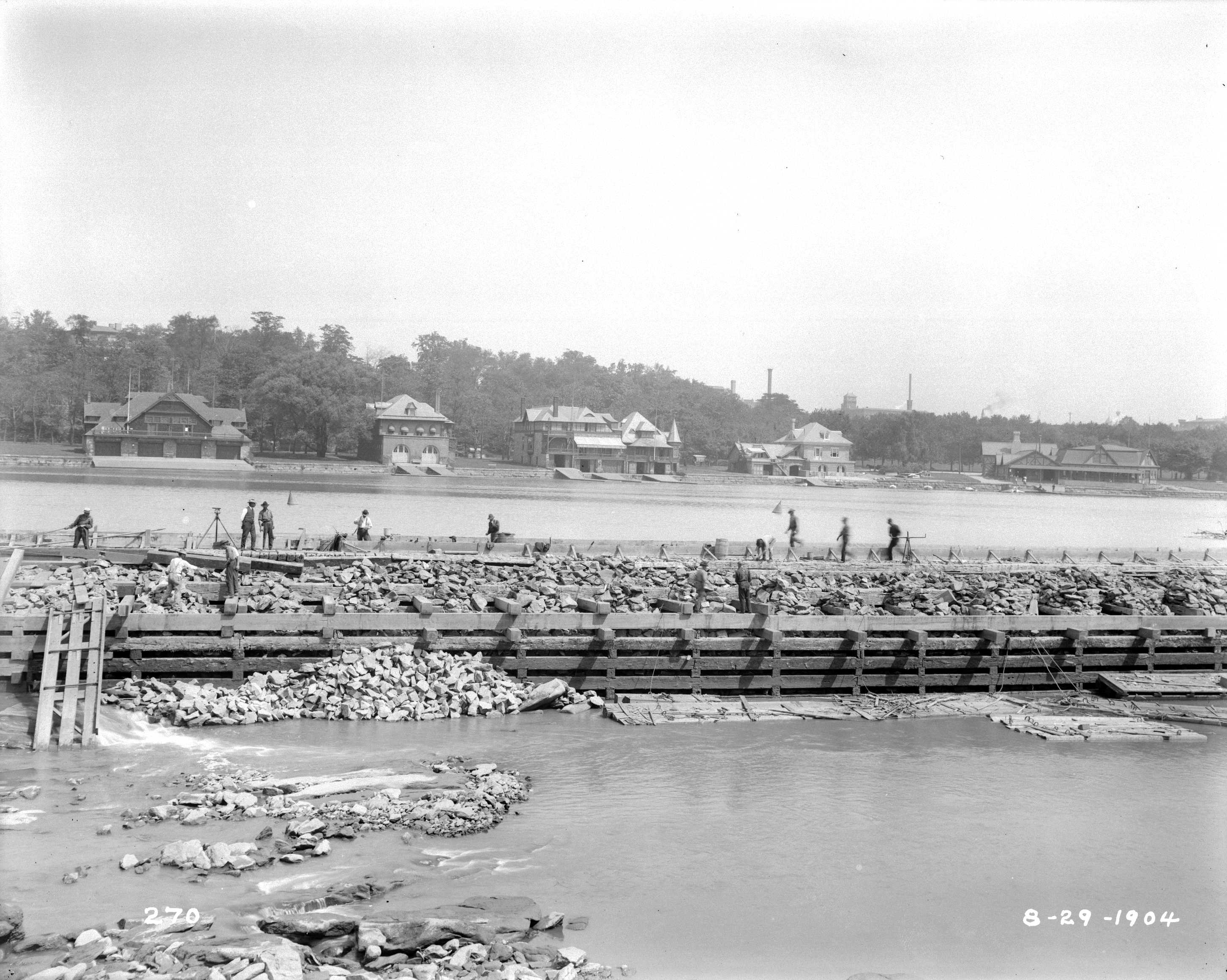
The Navigation Company proposed to build a system of canals, locks, dams and slackwater pools to make the Schuylkill navigable from tidewater to the coal fields in Schuylkill County, 115 miles upstream. In return for the right to use the river’s water for power and as a supply for its citizens, the city agreed to build a dam at Fairmount along with a canal and locks to allow boats to get around the dam. The river was about 1,000 feet wide at the point of the dam, which would be the longest in the United States at that time. Construction began in 1819, the work on the dam undertaken by Captain Ariel Cooley, of Chicopee, Massachusetts.
The river was impounded by four distinct structures. An earth-filled masonry wall doubled as the wall of the lock at the entry to the canal on the western side of the river. A spillway, about 1,200 feet long, consisted of a series of wooden cribs built diagonally across the river the lessen the effects of freshets (or floods). A mound of earth (called the mound dam) 270 feet long was built where the mud on the river bottom was too deep to anchor wooden cribs. The fourth structure was the hollow masonry structure of the millhouse itself, 238 feet long, which housed the water wheels. Behind this building as the mill race (or forebay), 419 feet long and about 90 feet wide. The purpose of the forebay was to bring the river water, impounded behind this four-part dam, into the mill house through gates in the forebay wall, into flumes leading to the water wheels.
Each massive wheel, fifteen feet wide and fifteen or sixteen feet in diameter, turned at eleven to fourteen revolutions per minute, powered by the weight of water as it filled the long buckets affixed to the circumference of the wheel. A crank on the axle of the wheel transmitted the power generated by the turning wheel to the shaft of a pump. The pump sucked water out of the flume and pushed it through a pipe to the reservoir atop Fairmount.


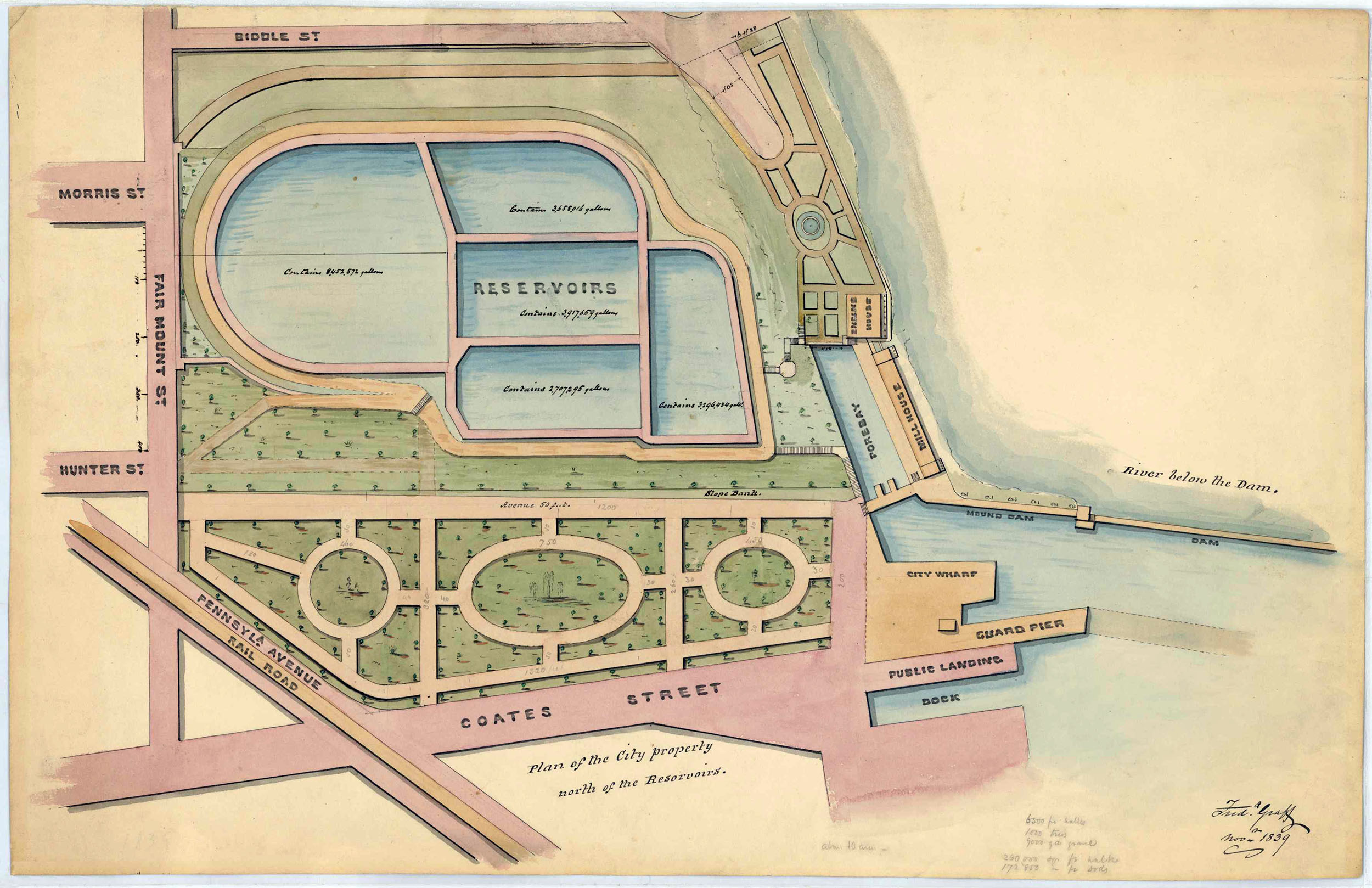
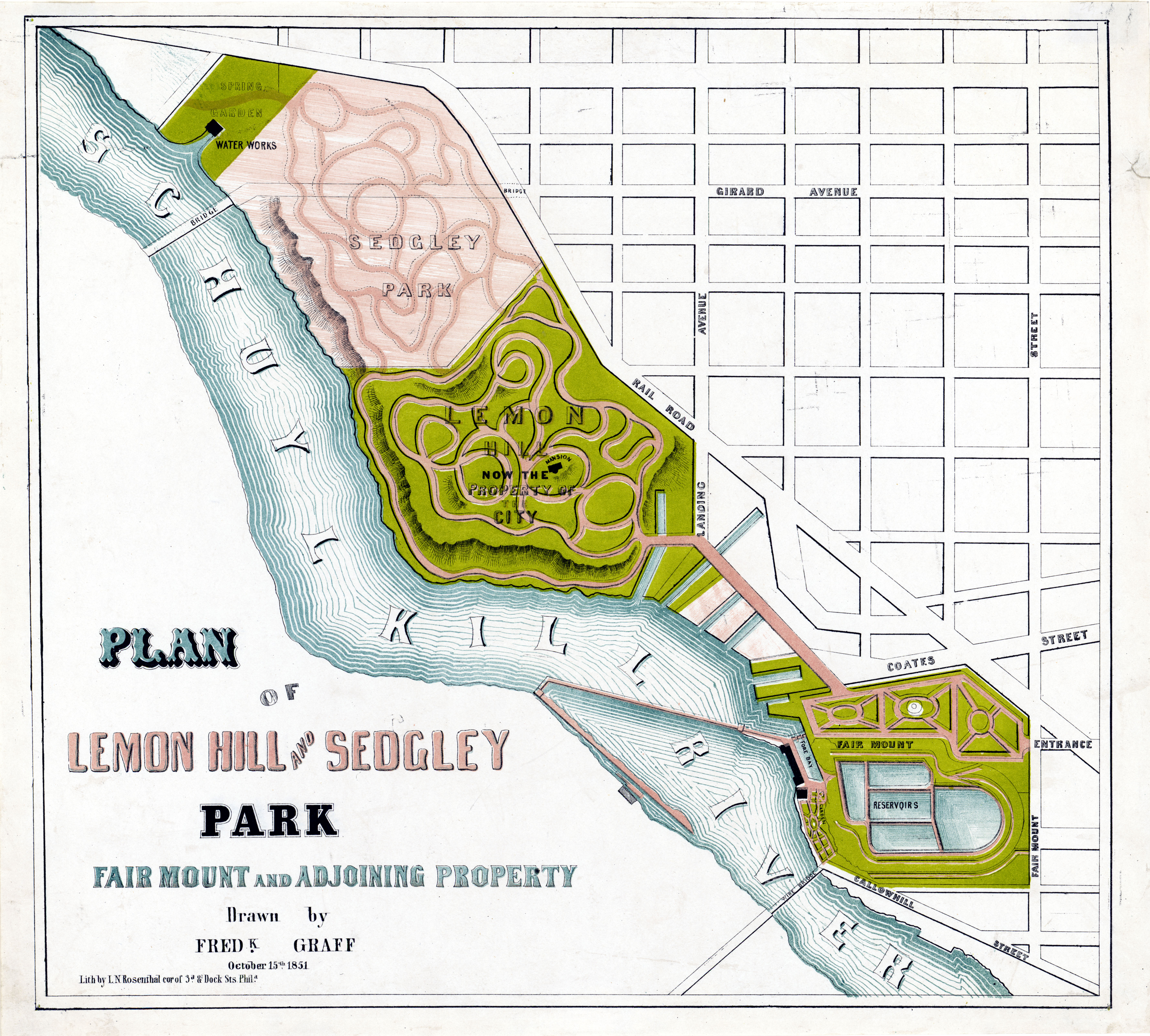
The first water flowed over the dam on July 23, 1821. By July of 1822, the first water wheel was installed and at work in the mill house. By the end of October two more wheels were installed, and the steam engines were taken out of service. As the city grew and the need for water grew with it, more wheels were installed and more reservoirs built on the hill. By 1837 the full complement of four reservoirs atop Fairmount were completed, with an aggregate capacity of xxx million gallons. By 1843 the mill house had reached its capacity, with eight water wheels in operation. By then the engine house had been converted into a saloon serving refreshments, and the quarry to the south of the water works had been transformed into the South Garden and Esplanade. With a staircase leading up to the heights of the reservoir providing beautiful views of the river to the west and the city to the east, the Fairmount Water Works became one of the city’s must-see tourist destinations.
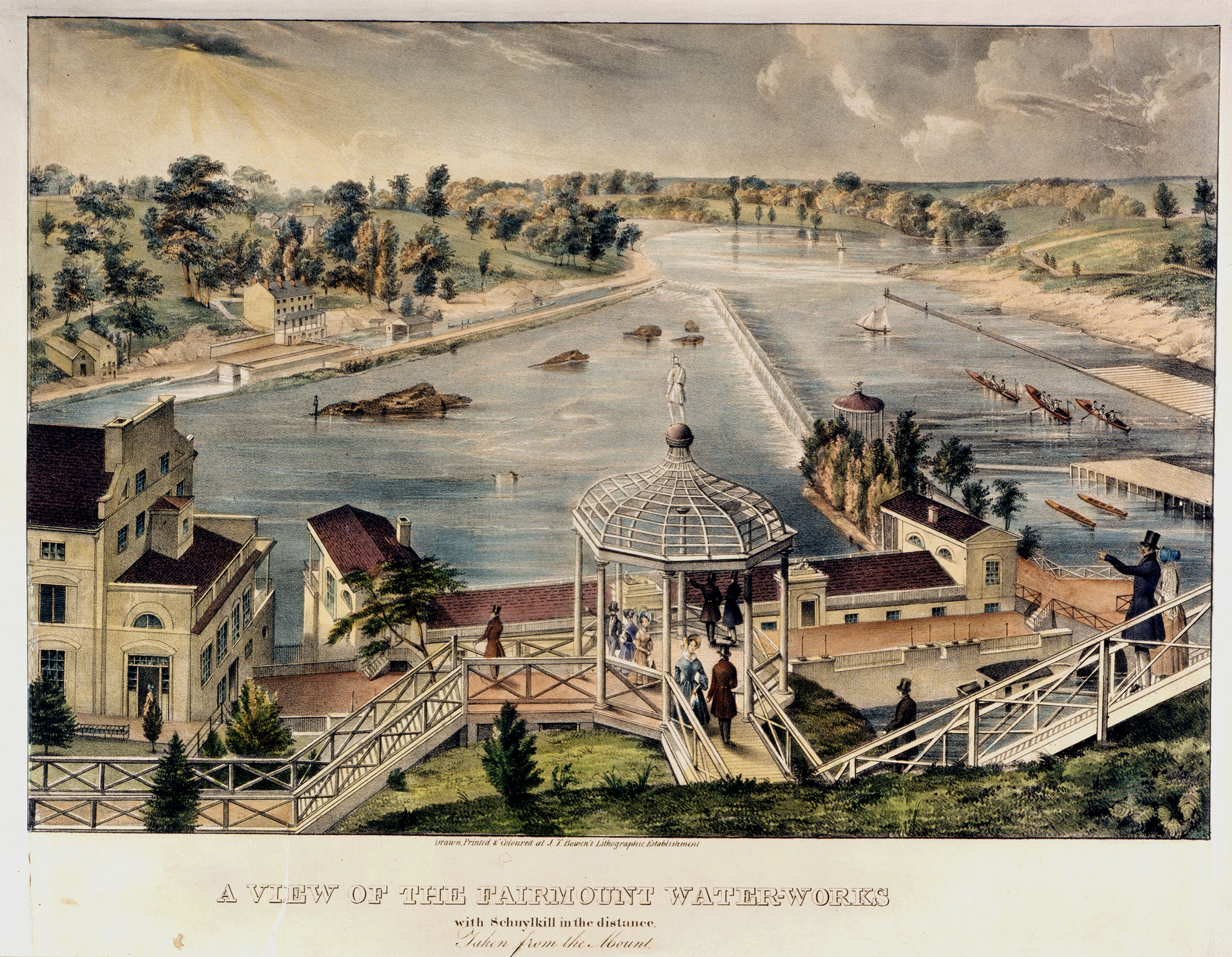
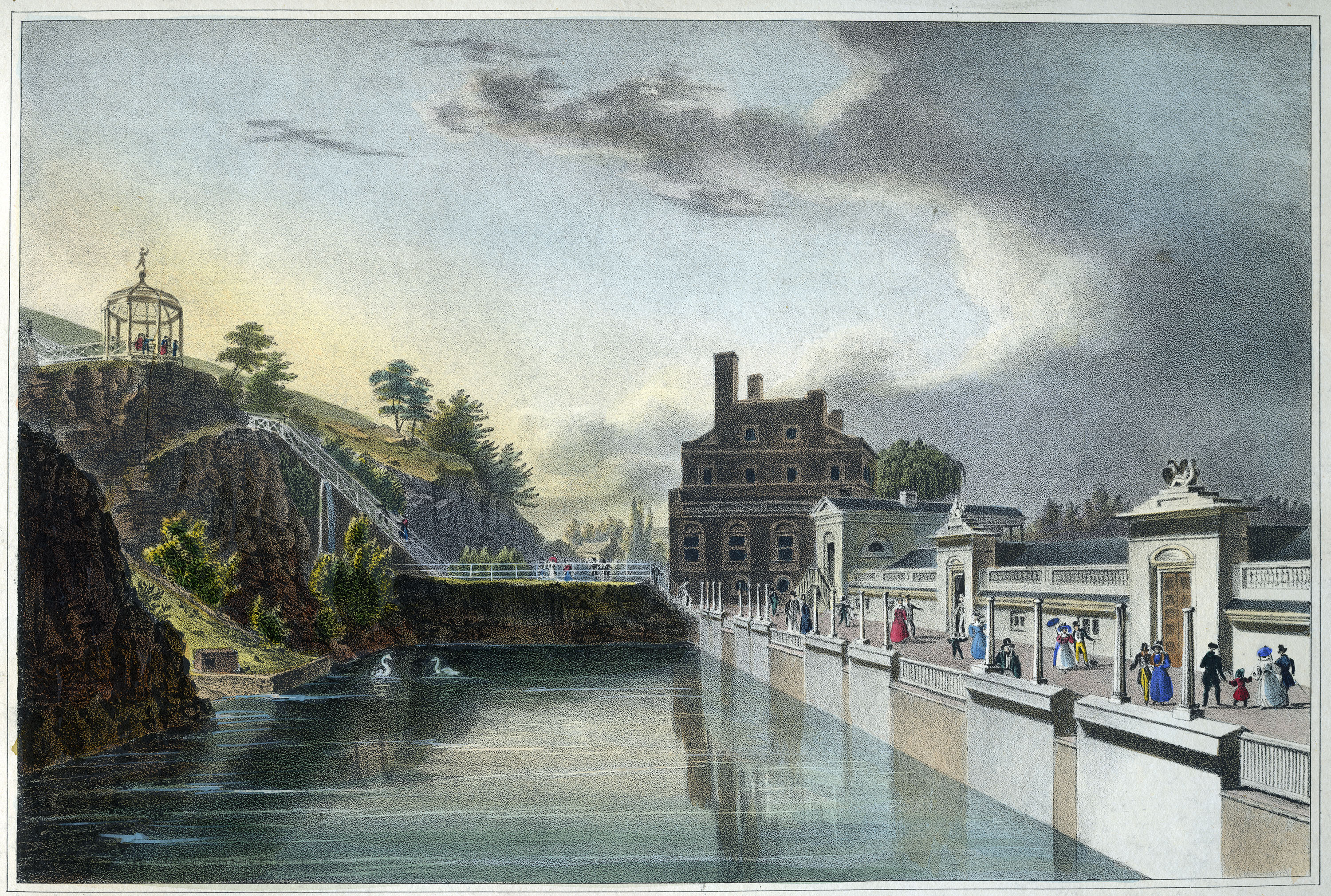
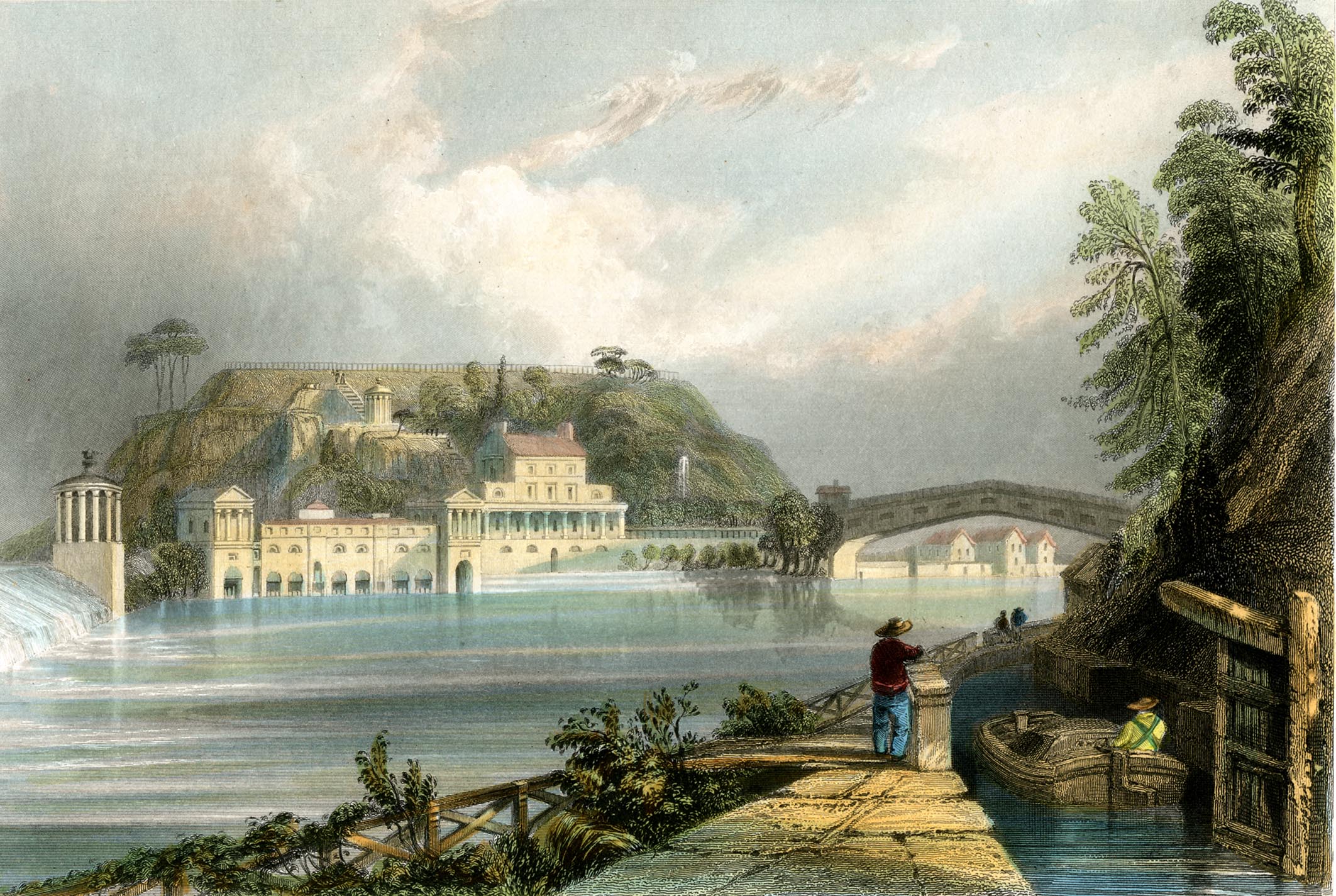

Describing a visit to Fairmount in 1840, Thomas Ewbank, inventor and manufacturer, wrote: “It is impossible to examine these works without paying homage to the science and skill displayed in their design and execution; in these respects no hydraulic works in the Union can compete, nor do we believe they are excelled by any in the world. Not the smallest leak in any of the joints was discovered; and, with the exception of the water rushing on the wheels, the whole operation of forcing up daily millions of gallons into the reservoirs on the mount, and thus furnishing in abundance one of the first necessaries of life to an immense population, was performed with less noise than is ordinarily made in working a smith’s bellows! The picturesque location, the neatness that reigns in the buildings, the walks around the reservoirs and the grounds at large, with the beauty of the surrounding scenery, render the name of this place singularly appropriate.”[1]
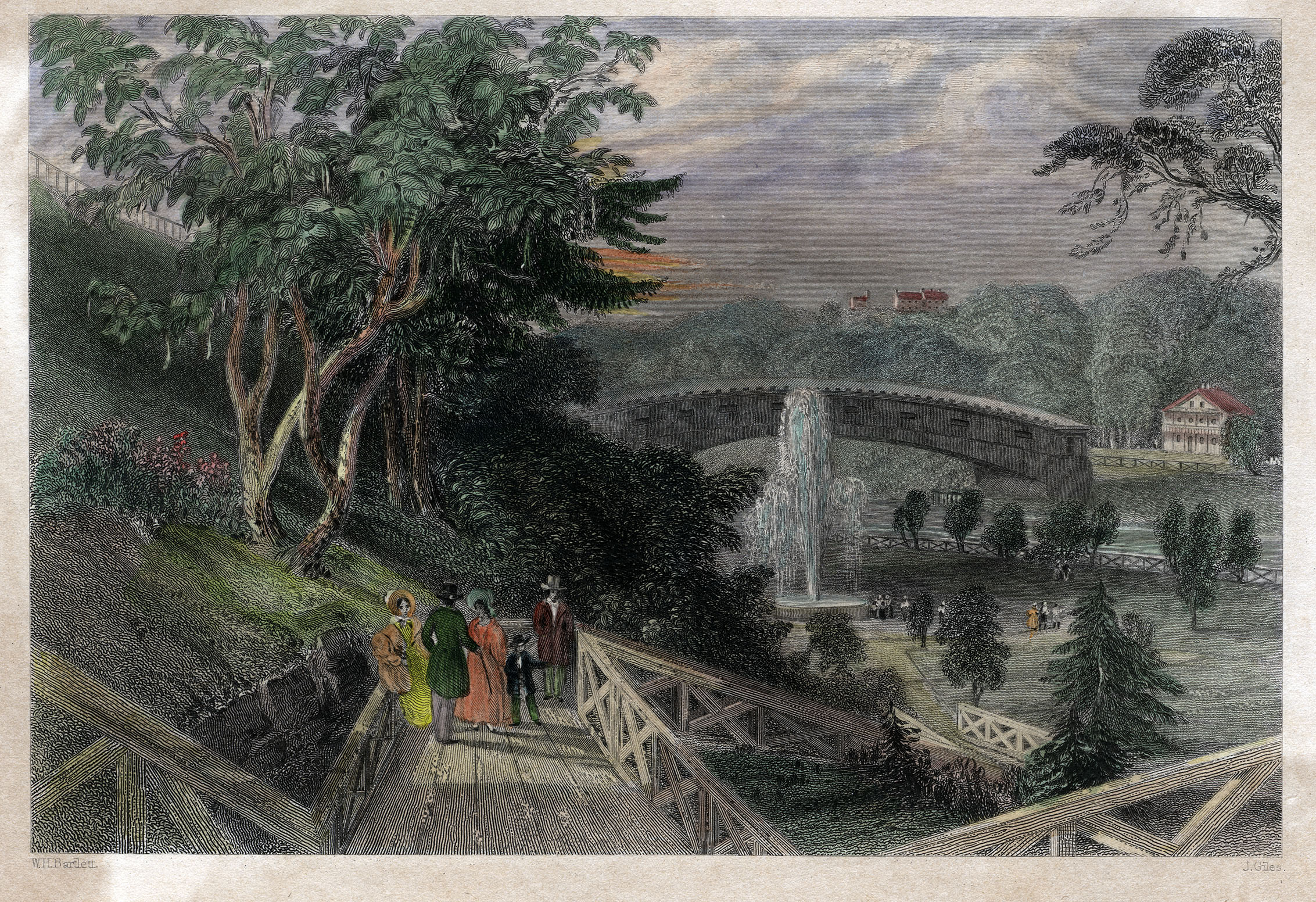
European visitors were greatly impressed with the beauty and the power of the works, especially since it had been conceived and built in this country by locally trained engineers. Charles Dickens visited and had kind words for Fairmount, and English novelist Frances Trollope offered high praise as she recorded her visit to the waterworks in 1830. She considered it as deserving of fame as the water-works at Versailles, and called it “one of the very prettiest spots the eye can look upon.”[2] In 1851, in an attempt to provide more water more efficiently, a new technology was given a try at Fairmount. Frederick Graff Jr., who had succeeded his father as chief engineer, installed an experimental Jonval turbine, a type of horizontal waterwheel introduced in this country by the French engineer Emile Geyelin. (Portions of this turbine can still be viewed at the Water Works Interpretive Center.) This turbine proved so successful that a new mill house was constructed on the mound dam in between 1859 and 1862, and old mill house was altered between 1868 and 1872. With this conversion, the pumping formerly provided by the eight waterwheels was now undertaken by seven Jonval turbines.
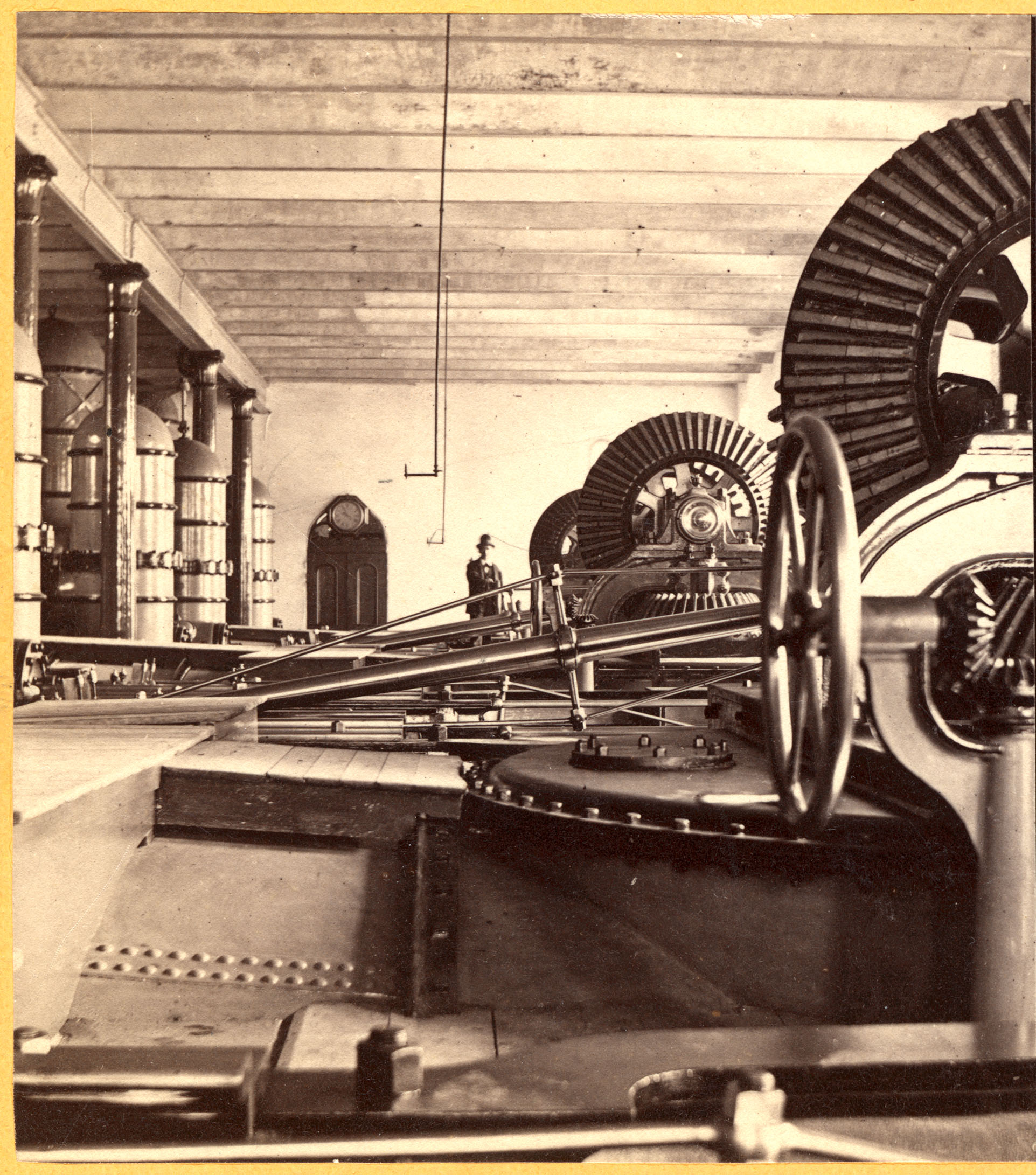
Engineer Emile Geyelin brought the technology for the turbines from France in 1849 and built a successful business from scratch, selling turbines and designing installations for them up and down the east coast of the United States. The large clock in the Mill House helped the operator accurately record running times for the turbines. The roof of the Mill House, designed to be fire-proof and space-saving, incorporated narrow brick vaults between the flanges of wrought-iron beams that sat on massive, composite, riveted, wrought-iron joists, all supported by cylindrical cast-iron columns. This innovative structural system, manufactured without wooden components at the Phoenix Iron Works in nearby Phoenixville, PA., revolutionized the architecture of industrial, utility, and transportation structures, including subsequent renovations to the Old Mill House and to the roof of the 1851 Turbine and Pump Room. The air vessels in the photograph — critical shock-absorbing components of the pumping system that dampened potentially-destructive water hammer – and the columns supporting the roof were decorated with multiple colors of paint in the Victorian style, creating an attractive interior.
By then Fairmount had become the prototype of a water-supply system for growing urban areas in the United States and abroad. Graff acted as consultant for more than thirty-seven other waterworks, and Philadelphia became the “Mecca of the hydraulic engineer,” according to Emile Geyelin. [3] In 1844 the Fairmount Water Works supplied an average of 5.3 million gallons of water per day to 28,082 water users. Expenditures were $29,713, and the amount paid into the treasury was $151,501. This marked a high point for revenues, generated, in part, by water rates paid by neighboring districts where assessments were fifty percent above the rates paid by Philadelphians.
The conversion to turbines marked the last of the innovations at Fairmount. Beginning in the 1840s the city began purchasing land upstream of Fairmount, in an attempt to protect the Schuylkill River from pollution. The largest purchases of thousands of upstream acres in the late 1860s and early 1870s, giving form to Fairmount Park as we know it today.
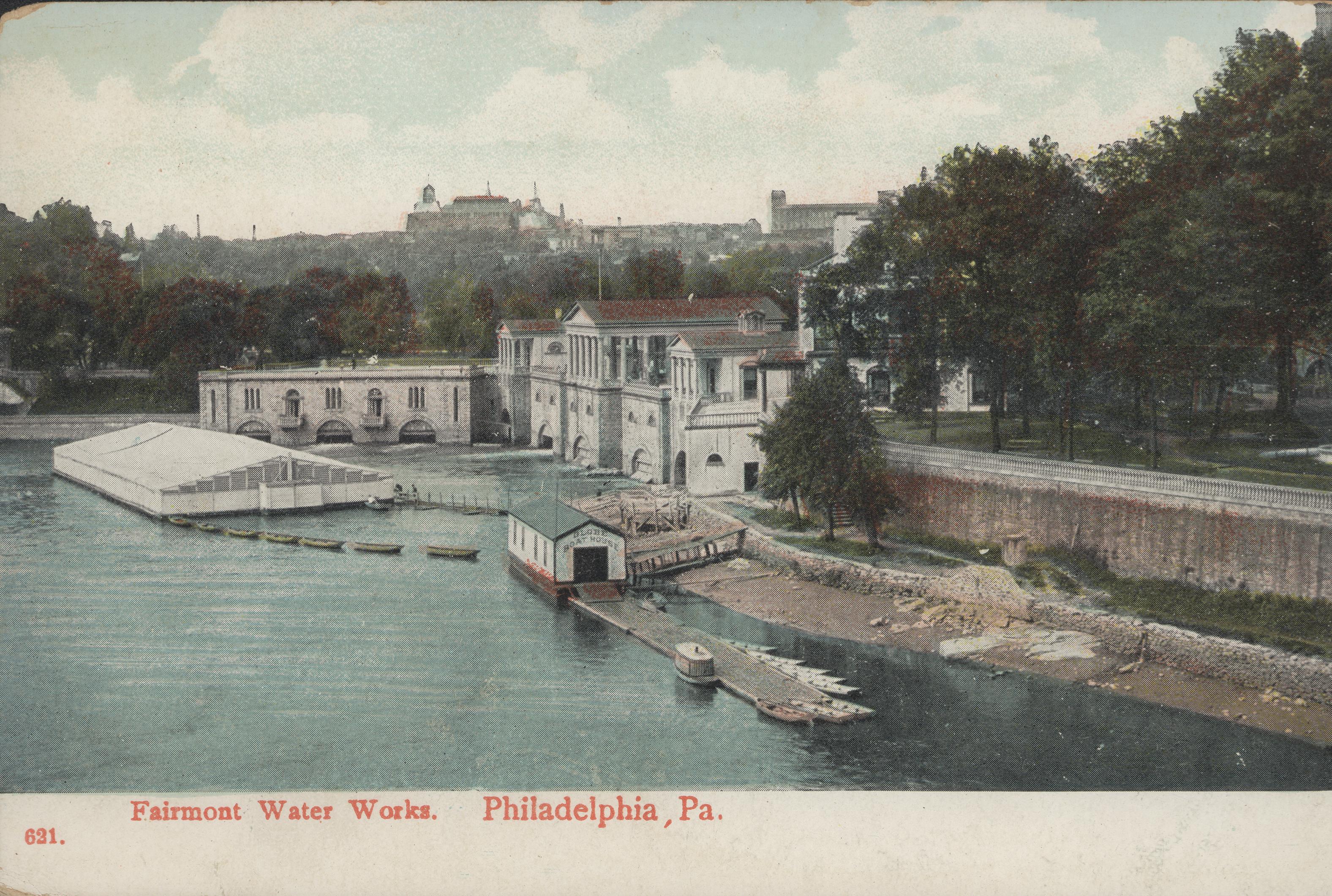
In spite of this attempt at watershed protection, as the century wore on the river grew more polluted. Epidemics of typhoid fever and other water-borne diseases were annual events, with typhoid alone killing more than 27,000 citizens in the half-century following the end of the Civil War. Eventually filtration of the city’s water supply to remove disease-causing bacteria was implemented as a solution. But Fairmount, with the limited land on the hill, had no room for the large filters required to purify the polluted river water. Five filtration plants were built elsewhere in the city, and once they were in operation, in 1909, the Fairmount Water Works was decommissioned as part of the city’s public water supply. For a couple of years one manufacturer continued to use raw water pumped at Fairmount for industrial processes, but in 1911 the water works at Fairmount was shut down completely.
RETURN TO COURSE HOME PAGE
or
PROCEED TO PART 6
FOOTNOTES
[1] Thomas Ewbank, A Descriptive and Historical Account of Hydraulic and Other Machines for Raising Water. (New York, 1842), p. 301
[2] Frances Trollope, Domestic Manners of the American. Vol. 2. London: Whitaker, Treacher & Co., 1832, p. 74-75.
[3] Emile Geyelin, “Growth of the Philadelphia Water Works” (Proceedings of the American Water Works Association, Philadelphia, 1891, p. 21).